
Strengthening Feminist Solidarity and Collective Power: WHRD-IC’s Renewed Governance and Membership Policy
In 2025, the Women Human Rights Defenders International Coalition (WHRDIC) undertook a significant renewal of its governance structure and membership policy. This shift forms part of a broader transformative process aligned with the Coalition’s new Strategic Framework for 2025–2030. At its core, this renewal reflects the Coalition’s commitment to building a feminist and decolonial future which centres WHRDs, feminists, trans and non-binary defenders in the Global South.
Our renewed governance and membership policies are living, collective agreements among our members, rooted in our shared purpose as a transnational feminist Coalition. They guide us on how we make decisions, hold power, care for one another, remain accountable to each other, to our communities, and to the movements of which we are part, in the face of intersecting global crises and escalating repressions.
Why This Renewal Matters
The revised governance model is designed to build on the Coalition’s herstory and mission of bringing together feminist, women’s rights, and human rights organisations to foster dialogue between feminist and human rights groups. It centers care, accountability, solidarity, and collective resilience.
Our new governance structure responds to the reality of the current situation of the WHRDIC, which includes both significant steps forward to revive and rejuvenate our collective work as a Coalition since 2022, and challenges in terms of resources and capacity. It links clearly to the WHRDIC’s commitment to expand its membership, and in particular to increase the presence of national and regional organisations of WHRDs in/from the Global South.
We take a step-by-step approach to the transformation of the WHRDIC’s governance structure so as to ‘test’ the effectiveness of the structure, learn from the experience, and make collective decisions on the next steps, as needed.
New Membership Policy: Growing a Diverse and Committed Coalition
The WHRDIC operates through a participatory model that reinforces transparency, trust-building, and collective leadership.
The Coalition has now two types of membership:
● Members: Organizations working with and for WHRDs, feminists, trans and non-binary defenders which actively participate in coalition activities and decision-making.
● Affiliated Members: Individuals and feminist funders working with and for WHRDs, which actively participate in coalition activities but do not participate in decision-making.
Only members of WHRDIC have voting rights. Affiliated members do not have voting rights but may participate in discussions in the General Assembly that lead to decision-making.
Individuals applying to become affiliated members is not encouraged and is considered only from: WHRDs from countries and constituencies where there is very limited or no civic space for activism; individuals who have actively contributed to the Coalition’s work in their capacity as staff of a member of the Coalition upon leaving the member organisation. Affiliated members may not make up more than 20% of the Coalition's membership. For the period, 2026 - 2028, there is a moratorium on new affiliated members until this quota is achieved.
We have collectively set priorities for growing our membership through to the end of 2027. We will soon open up our membership and welcome membership applications from regional and national organisations from the Global South, particularly working on the rights of WHRDs, trans and non-binary defenders. Please check our website and social media channels to learn more about the application process and membership criteria.
We aim to address the regional, issue and movement-related gaps in our current membership. For this, we will not accept membership applications from international NGOs and will not have new affiliated members in 2026-2027.
New Governance Structure: Collaborative, Accountable, and Rooted in Care
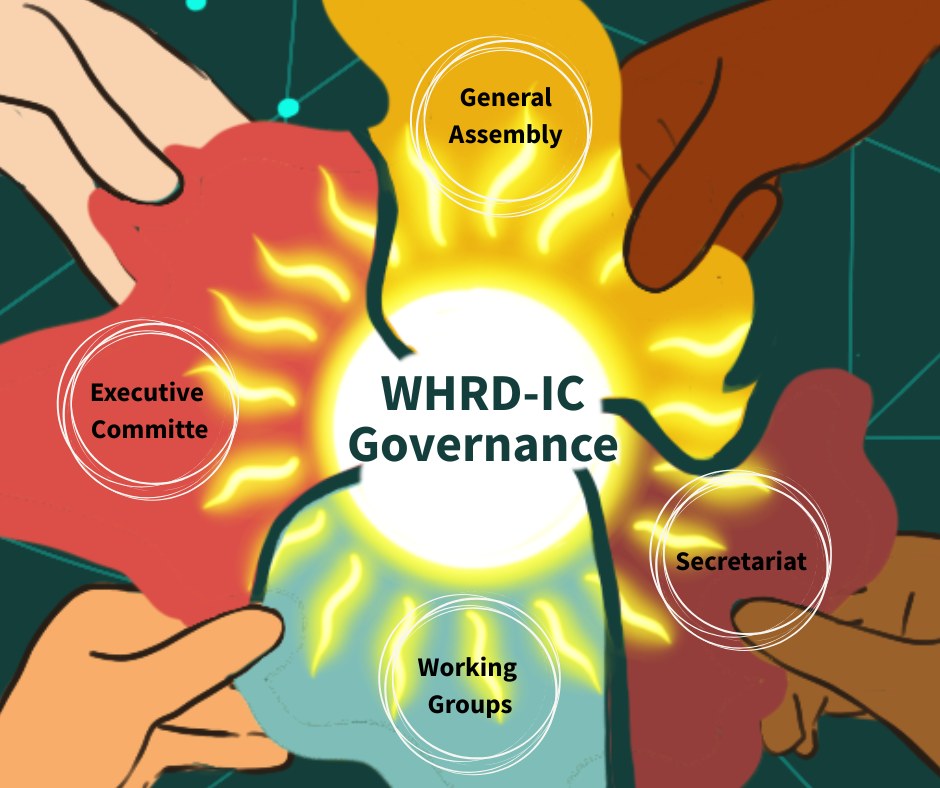
According to the new structure, the Coalition’s governance is composed of four main bodies:
General Assembly (GA)
The General Assembly is the Coalition’s highest decision-making body. It includes all members and affiliated members, though only members hold voting rights. The General Assembly sets strategic direction and political positions of the Coalition, oversees governance bodies and working groups, reviews the annual work plan, approves policies, makes membership decisions and elects the Executive Committee.
Executive Committee (ExCom)
The ExCom holds fiduciary responsibility, ensures legal and ethical compliance, oversees financial and risk management, supervises the Secretariat and elects the Executive Coordinator. It is composed of two global and three South-led members of the Coalition and the fiscal host of the Coalition. The Executive Coordinator is a non-voting member of the ExCom.
Members of the ExCom are elected by the GA for a term of three years, with the possibility of re-election for a maximum of two consecutive terms.
Secretariat
Led by the Executive Coordinator, the Secretariat ensures day-to-day operations align with the Coalition’s strategic goals. It coordinates working groups, manages resources, facilitates internal and external communication and fundraising efforts.
Working Groups
The Coalition’s collective work is carried forward through various Working Groups, each composed of the Executive Coordinator and at least three members or affiliated members of the Coalition.
Conflict as a Path to Collective Resilience
Acknowledging that conflict is an inevitable and natural dynamic in our movements and in the contexts where we work, the WHRDIC has introduced a new Conflict Resolution Policy. This Conflict Resolution Policy is designed to promote a safe, respectful, and inclusive environment for all members of the WHRDIC. It provides a framework to prevent, mitigate, manage, and resolve conflicts constructively, aligned with the coalition’s feminist values, and principles of care and solidarity.
In our strategic framework 2025-2030, we committed to working together differently as part of co-creating a feminist and decolonial future for the Coalition including: making cornerstones of the Coalition's work love as a political act and collective care; prioritising trust building and belonging; tapping into our collective power; collectively finding best practices for dismantling power and privilege in the Coalition; embracing disagreement and dissent as signs of genuine involvement and care; and building consent at each stage of our collective work. Linked to these commitments, we believe that when we address conflict with intention and care, it can become a tool for our collective resilience as a Coalition.
The policy emphasizes:
- Prevention through clear roles, rotating leadership, and consent-based decision-making;
- Encouragement of informal resolution, where appropriate and safe;
- Formal processes including submission of concerns (with the option of anonymity), facilitated dialogue, mediation, or restorative practices;
- Commitment to confidentiality and protection against retaliation.
The conflicts are addressed by the Membership and Feminist Politics Working Group at the WHRDIC. Where needed, unresolved cases may be escalated to the General Assembly. Conflict is not seen as failure, but as a vital process for deepening accountability and collective strength.
Termination of membership is a last resort, reserved for serious breaches of Coalition values, and follows a fair process. Former members may apply for restoration if they meet conditions for accountability and healing.
Looking Ahead: A Stronger, More Grounded Coalition
The WHRD-IC’s renewed governance and membership policies are not just procedural updates - they are political commitments. They reflect who we are in this feminist space grounded in care, solidarity, accountability, and resistance. They strengthen our ability to act collectively across borders, identities, and movements to sustain our collective power. We hope that our new structure and framework will be also useful for our peers.